
Are You Thinking What I'm Thinking?
The hidden assumption behind every conversation you've ever had.

One of the formative experiences that led me to a fascination with the brain and human behavior was an undergraduate course in logic. I remember that some of it was pretty dry stuff (especially symbolic logic). But one thing that caught my imagination was the subject of logical fallacies.
Fallacies are basically flaws in thinking. In his book, “Thinking, Fast and Slow”, psychologist Daniel Kahneman divided the mind into System 1 (fast, intuitive, emotional) and System 2 (slow, logical, requiring more cognitive effort). Fallacies usually represent System 1 thinking, taking a shortcut. Instead of doing the hard work of verifying evidence, our brains prefer “what feels right”. This can be useful for rapid decision making, but (because it’s not grounded in logic) it’s prone to error.
There are hundreds of logical fallacies. But one in particular offers a surprise twist that can occasionally shock you: the false consensus fallacy. This is the intuition that if you believe something about a subject, then other people tend to believe the same way. Sometimes, a consensus intuition is safe: there’s a reason cute animal videos exist, most people probably think babies are adorable, and most Americans are sold on the importance of democracy (though, sometimes I wonder).

But the problem is, we’re not in each other’s heads, so in our normal interactions with people we must assume that we have common ways of thinking. This capacity is called “Theory of Mind”. It’s a useful feature of human brains that enables us to get along with others. But it’s imperfect, and the false consensus fallacy is one of its characteristic errors, a tendency to assume that others share our beliefs, experiences, and ways of thinking.
Don’t believe me? Close your eyes (Okay, not yet. I need to ask you to do something first, then close your eyes.)
Picture an apple. A red one, resting on a surface in your home. Maybe there’s a leaf still attached to the stem. Maybe it’s just been washed, and there are little beads of water on the skin. The skin itself may have a few dings and imperfections from being jostled around.
Do you see it in your mind’s eye?
For most people, that image appears quickly. The apple might rotate. Light might catch the skin. You can change its color, make it glossy, even imagine a bite taken out of it.
But did you know that for anywhere from 2 to 5 percent of people, nothing appears? There’s only the idea of an apple without any picture attached.
That experience is called aphantasia. It describes the inability to voluntarily create mental images. You can think of it as a “blind” mind’s eye. If the apple showed up clearly for you, it can be hard to grasp what that absence feels like. And if it didn’t, you may have just discovered something interesting about yourself.
The phenomenon isn’t new. In 1880, Francis Galton (a controversial figure who was an early proponent of eugenics) mailed out what became known as the “breakfast table” questionnaire. He asked respondents to picture their breakfast from that morning and rate how clearly they could see it.
The answers varied widely. Some described images as vivid as if they were looking at the objects, down to the shine. Others reported faint impressions. A few wrote responses like: “My powers are zero. I recollect the breakfast-table, but do not see it.” Mental imagery, something many assumed was universal, turned out to vary dramatically.
Public interest in aphantasia resurged in 2015, when neurologist Adam Zeman described a patient known as MX who lost his ability to form mental images after a medical procedure. While MX’s eyesight remained normal, his capacity to visualize was diminished.
When Zeman introduced the term “aphantasia,” people began writing in. Many said they had never formed mental pictures, not in childhood, not in dreams they could recall, not ever. They assumed phrases like “picture this” were figurative.
For decades, the topic had drifted to the margins of psychology. Some researchers may have assumed people were describing the same inner experience with different words. Zeman’s work brought it back into focus.
But the reality is much more complex. In fact, it’s not “reality” at all.
Every Image is a Mental Image
Folks with normal sight can see and perceive their world, so what does it mean that some people can’t conjure these images in their imagination? And, where do images come from, anyway?
There is no little screen in your head. The last place a literal image exists for your brain is at the retina, when light from the apple is focused onto photoreceptors at the back of the eye. At that moment, photons strike molecules such as rhodopsin, starting a biochemical cascade of turning light into neural signals. After that, there are only patterns of electrochemical activity representing the inputs from the external world.
From those signals, your brain builds a model of the world. Early visual areas in the occipital lobe (part of the brain near the bump on the back of your skull) decode edges, contrast, color, shape, and movement. Other regions handle faces, objects, and meaning (Figure 2). Before you could speak or walk, your brain was already learning which patterns correspond to mugs, doors, friends, and threats, long before you knew what they were called. Vision feels immediate and effortless, but it is already an act of interpretation borne of developmental plasticity. There’s no little screen inside your head, no little observer watching it. The brain works in darkness from cradle to grave, assembling a model of the world from decoded patterns of electrical signals that were first encoded in your eye. I’ve studied it for most of my life, but it always freaks me out a little to think about it.
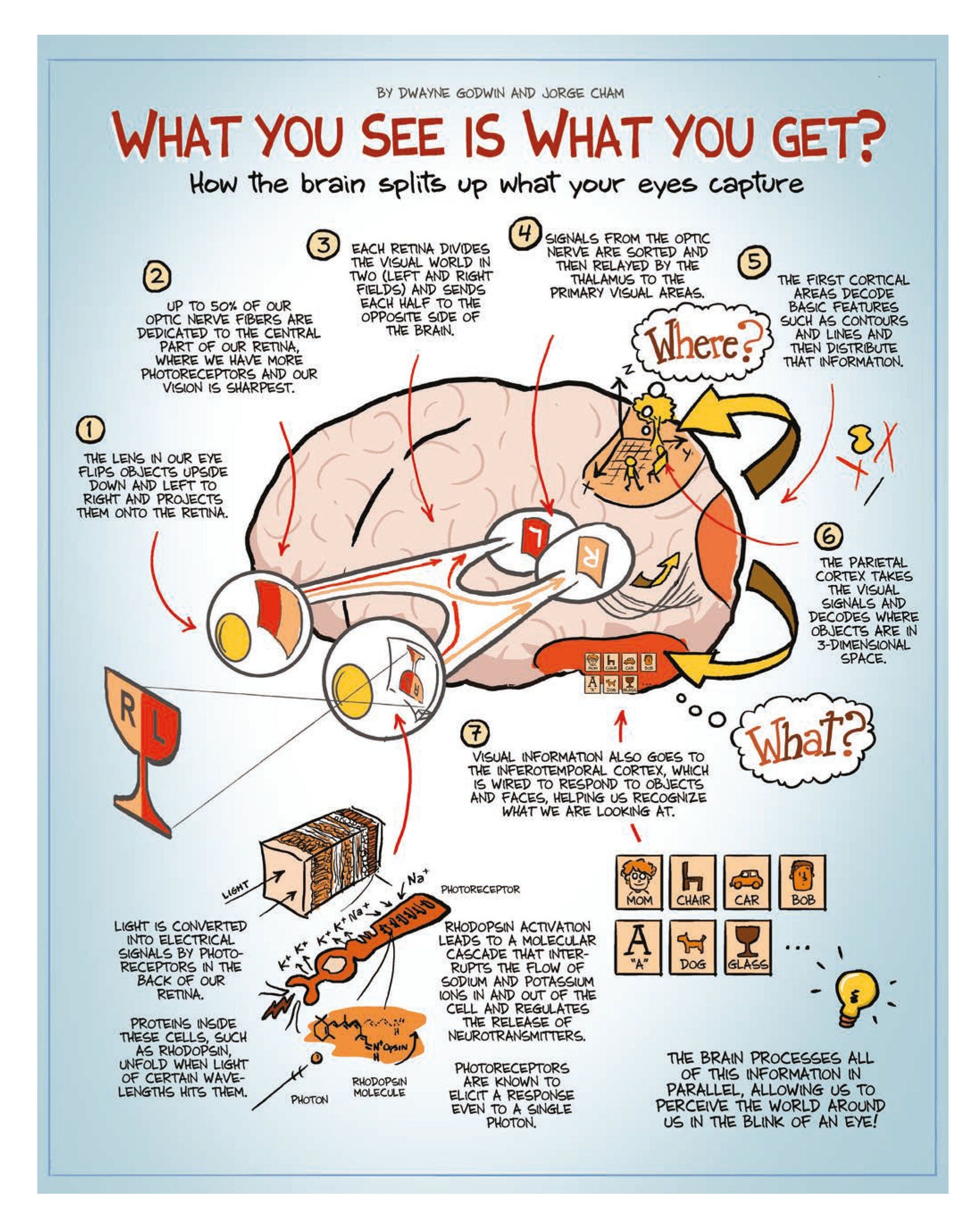
This communication doesn’t just flow one way. At the same time the information-bearing pathways are developing, strong feedback connections are also forming at all stages where visual images are processed.
This is needed because vision also depends on expectation. When you glance at a familiar face, you are not rebuilding it from scratch. The brain predicts, fills in gaps, corrects, and updates. These feedback connections seem to help with this.
Mental imagery uses much of the same visual circuitry, but the starting point is different. The machinery for building visual knowledge is there in everyone with normal sight. What differs in aphantasia is how, and how vividly, that knowledge can be called back up by reactivating those feedback circuits.
Reversing the Flow
When you imagine the apple, higher brain regions involved in memory and planning activate patterns in visual cortex. Instead of the initial spark of light driving the neural signal upward, stored information pushes activity back through the system to reignite those early circuits. This seems to be a key physiological difference between those who conjure vivid images, and those who cannot.
Imaging studies show overlapping regions engaged during both seeing and imagining, though the timing and intensity differ. Visual perception tends to begin in visual cortex and move forward, but “mental” imagery often begins in higher regions and recruits visual areas afterward, basically reversing the flow.
Remember that some people report extremely vivid imagery (sometimes described as hyperphantasia) but others report none. Research suggests these differences relate to how strongly higher-order areas drive the earlier processing in the visual cortex.
To test whether this is subjective reporting, or a measurable difference, researchers use tasks like binocular rivalry. By presenting different images to each eye, perception is observed to alternate between them. If the person being tested this way imagines one of the images beforehand, that image is more likely to dominate when the display appears. For people with aphantasia, this priming effect is greatly reduced or absent.
In essence, your thoughts change your perceptions.
Measuring changes in pupil diameters (Pupillometry) shows a similar pattern. Pupils constrict in response to real brightness. But in many people, they also constrict slightly when just imagining something bright. In aphantasia, that imagined-light response tends not to appear, even though responses to actual light remain normal.
So aphantasia seems to involve a disruption of how feedback systems are recruited from regions where images are encoded.
Thinking without Images
So, what does daily life feel like without mental imagery?
The first thing I wondered is whether a reduced ability to form mental images might affect the response to scary things (take snakes, for example. Would the mental image of a snake be scarier than just the concept of a snake?).
Turns out, someone else was curious about this and in lab studies, people with aphantasia often show reduced physiological responses when reading frightening scenarios compared to strong visualizers. The difference seems tied to imagery rather than emotional capacity. In other words, you can still be scared, but it’s harder for you to scare yourself.
Many readers describe novels unfolding like a movie in their minds. Others track plot and character without any internal picture. They follow structure, dialogue, and meaning. For them, comprehension does not require imagery.
Visualization exercises rely on the assumption that imagined scenes evoke bodily responses. For many people, they do. But for someone without imagery, the exercise may function more as conceptual rehearsal than sensory simulation. Neither approach is inherently better, they’re just different ways minds work. And many remarkable minds have worked quite well without it.
Making it Work
You might intuit that aphantasia would preclude creative process. But in fact, well-known creative figures have described aphantasia. Ed Catmull, former president of Pixar, has said he does not visualize scenes internally. Oliver Sacks, famous for his accessible writings about neurological conditions, wrote that he could summon only faint, unstable images.
That raises an obvious question: how do people create visual art (Catmull) or vivid, emotional prose (Sacks) without strong mental pictures?
Studies suggest that people with aphantasia often rely more heavily on semantic reasoning and external aids. In mental rotation tasks, they may approach the problem analytically rather than by picturing the object. Externalization via notes, sketches, outlines, and physical models become tools for thinking.
Animator Glen Keane has described discovering a drawing through the act of sketching itself. The paper becomes part of the thinking process. The image develops externally rather than being copied from an internal mental image. Basically, it seems the world becomes part of the brain’s space for working out these relationships.
Final Thought: What Else Are We Missing?
Besides the insights it provided into cognitive function, aphantasia is a dramatic example of how it’s not safe to assume that our minds are experiencing the same reality in quite the same way. And if we can’t completely rely on common internal mental experiences in the limited domain of mental imagery, what else might we be missing?
Conscious experience varies along multiple dimensions, including imagery, inner speech, emotional reactivity, cognitive control, and attentional style. We tend to assume our own thinking is typical because it is familiar. But are we considering that early developmental experiences, education level, religion, politics and culture could all affect, not just what we think, but how?
Understanding these differences has practical consequences. A teacher asking students to visualize a math problem may be speaking to very different internal experiences. A therapist guiding imagery may find it resonates strongly for some clients and not at all for others. Building meditation apps or using memory visualization tricks may be assuming a mental toolkit not everyone has.
Some may even be experiencing a complex range of emotions that can’t be completely shared by others, clouding attempts at empathy.
Through quirks of development or genetic inheritance, we all experience different internal worlds of our own making. What this really means is that our “Theory of Mind” may really be just a hypothesis.
-DWG
P.S. / My friend Jorge Cham and I talk about aphantasia on his podcast, Science Stuff.
[Dwayne Godwin is a NIH-funded neuroscientist who does research on PTSD, TBI and alcohol use disorder. He is the co-author of “Out of Your Mind: The Biggest Mysteries of the Human Brain”. The views expressed here are his own and do not necessarily reflect those of the National Institutes of Health or his employer.]
For Further Exploration
Dijkstra, N., Bosch, S. E., and van Gerven, M. A. J. (2019). Shared neural mechanisms of visual perception and imagery. Trends in Cognitive Sciences, 23(5), 423-434. https://pubmed.ncbi.nlm.nih.gov/30876729/
Dijkstra, N., Zeidman, P., Ondobaka, S., van Gerven, M. A. J., and Friston, K. (2017). Distinct top-down and bottom-up brain connectivity during visual perception and imagery. Scientific Reports, 7(1), 5677. https://pubmed.ncbi.nlm.nih.gov/28720781/
Gallagher, J. (2019, April 8). Aphantasia: Ex-Pixar chief Ed Catmull says ‘my mind’s eye is blind.’ BBC News. https://www.bbc.com/news/health-47830256
Galton, F. (1880). Statistics of mental imagery. Mind, 5(19), 301-318. https://doi.org/10.1093/mind/os-V.19.301
Kahneman, D. (2011). Thinking, fast and slow. Farrar, Straus and Giroux. https://www.amazon.com/Thinking-Fast-Slow-Daniel-Kahneman/dp/0374533555
Kay, L., Keogh, R., Andrillon, T., and Pearson, J. (2022). The pupillary light response as a physiological index of aphantasia, sensory and phenomenological imagery strength. eLife, 11, e72484. https://pubmed.ncbi.nlm.nih.gov/35356890/
Keogh, R., and Pearson, J. (2018). The blind mind: No sensory visual imagery in aphantasia. Cortex, 105, 53-60. https://pubmed.ncbi.nlm.nih.gov/29175093/
MacKissack, M., and Zeman, A. (2021). The art of aphantasia: how ‘mind blind’ artists create without being able to visualise. The Conversation. https://theconversation.com/the-art-of-aphantasia-how-mind-blind-artists-create-without-being-able-to-visualise-162566
Mar, R. A. (2011). The neural bases of social cognition and story comprehension. Annual Review of Psychology, 62, 103-134. https://pubmed.ncbi.nlm.nih.gov/21126178/
Pearson, J., Clifford, C. W. G., and Tong, F. (2008). The functional impact of mental imagery on conscious perception. Current Biology, 18(13), 982-986. https://pubmed.ncbi.nlm.nih.gov/18583132/
Sacks, O. (2010). The Mind’s Eye. Knopf.
Schaafsma, S. M., Pfaff, D. W., Spunt, R. P., and Adolphs, R. (2015). Deconstructing and reconstructing theory of mind. Trends in Cognitive Sciences, 19(2), 65-72. https://pubmed.ncbi.nlm.nih.gov/25496670/
Wicken, M., Keogh, R., and Pearson, J. (2021). The critical role of mental imagery in human emotion: Insights from fear-based imagery and aphantasia. Proceedings of the Royal Society B: Biological Sciences, 288(1946), 20210267. https://pubmed.ncbi.nlm.nih.gov/33715433/
Zeman, A. (2024). Aphantasia and hyperphantasia: Exploring imagery vividness extremes. Trends in Cognitive Sciences, 28(5), 467-480. https://pubmed.ncbi.nlm.nih.gov/38548492/
Zeman, A., Dewar, M., and Della Sala, S. (2015). Lives without imagery: Congenital aphantasia. Cortex, 73, 378-380. https://pubmed.ncbi.nlm.nih.gov/26115582/
Zeman, A. Z. J., Della Sala, S., Torrens, L. A., Gountouna, V. E., McGonigle, D. J., and Logie, R. H. (2010). Loss of imagery phenomenology with intact visuo-spatial task performance: A case of blind imagination. Neuropsychologia, 48(1), 145-155. https://pubmed.ncbi.nlm.nih.gov/19733188/