
Remembering the Future
We are time surfers, riding a wave of ephemeral moments toward a future of our own imagining.

“The Brain—is wider than the Sky—
For—put them side by side—
The one the other will contain
With ease—and You—beside—”
Emily Dickinson wrote those lines around 1862. The stanza is usually read as a meditation on the vastness of human imagination, the ability of the mind to contain the experience of the boundless sky. But the brain holds more than space. It can also hold time.
If I call your attention to it, you can perceive and estimate the passage of time required to read this sentence. I remember what I did this morning, yesterday, a year ago. I even have an early childhood memory of lying on an ironing board as my mother changed my diaper. I learned to trust—tentatively as a child, more firmly as I grew older—that the next moment in the flow of consciousness would arrive without incident, and would be followed by another, then another, too many to count. I can remember the past with pride or regret. I can imagine the future with joy or anxiety.
We can extend this trick beyond the boundaries of our own lives. We can mentally travel billions of years into the past, toward the beginning of the universe, or forward to imagine the death of our sun as it consumes the Earth. We can go further still, stretching across an ocean of time until the universe grows cold and winks out. The brain is wider than the sky, and more expansive than our own existence.
Physics has made time a strange companion. In everyday life, time seems like a river: one present moment flowing into the next, sometimes a lazy river, sometimes roaring rapids. But relativity made time local and observer-dependent. Clocks moving at different speeds, or occupying different gravitational fields, don’t agree perfectly with one another. Cosmology stretches time across nearly fourteen billion years of expansion. Thermodynamics gives time a direction: entropy increases and our bodies age. Living things resist entropy only temporarily.
Our sense of time may be the brain’s perception of the physics of time unspooling around us. The mind has no meter for entropy, but it can experience the consequences of irreversible change: growth, decay, loss, and memory. The physical world supplies succession and direction. Biology makes that direction intimate. Memory turns it into a life.
The brain seems to build a model of time that is tied to the narrative structure of human existence. In this way, time is the page upon which our stories are written. The components of this biographical model include memory, attention, bodily state, and imagination. Some timing is clock-like: the few milliseconds required to coordinate a movement, the beat of a rhythm, the interval between a flash and a sound. Those forms of timing depend heavily on brain areas including the cerebellum, striatum, thalamus, prefrontal, and parietal circuits. But “felt time” (to borrow Marc Wittmann’s phrase) seems different. It is the subjective continuity that allows us to experience a passing moment as part of a life story. In a prior post I explored consciousness as “the feeling of being you”. That feeling is knit together across moments that provide continuity to your consciousness. You feel that you are the same “you” you were yesterday, today, and who you will be tomorrow.
Memory ties most naturally to the elements of time contained in the past. Whether yesterday or a moment ago, the past exists for us because the memory of it was encoded by our senses, laid down on the imperfect recording medium of human neural circuitry, then accessed and reconstructed at a later moment. It seems obvious that those personal experiences we label “past” are also labeled “memories.” It is less intuitive to say that our sense of time itself may depend on memory.
The brain takes a few milliseconds to convert stimulus to response, so even the present we experience is already slightly behind the world—a wave of existence always frozen just before it crashes, like the helpless boatmen featured in the Great Wave off Kanagawa. The gap is so brief that we rarely notice it. From an evolutionary perspective, that blink of delay is usually small enough not to matter, and our brains are good enough prediction machines that we get along well enough.
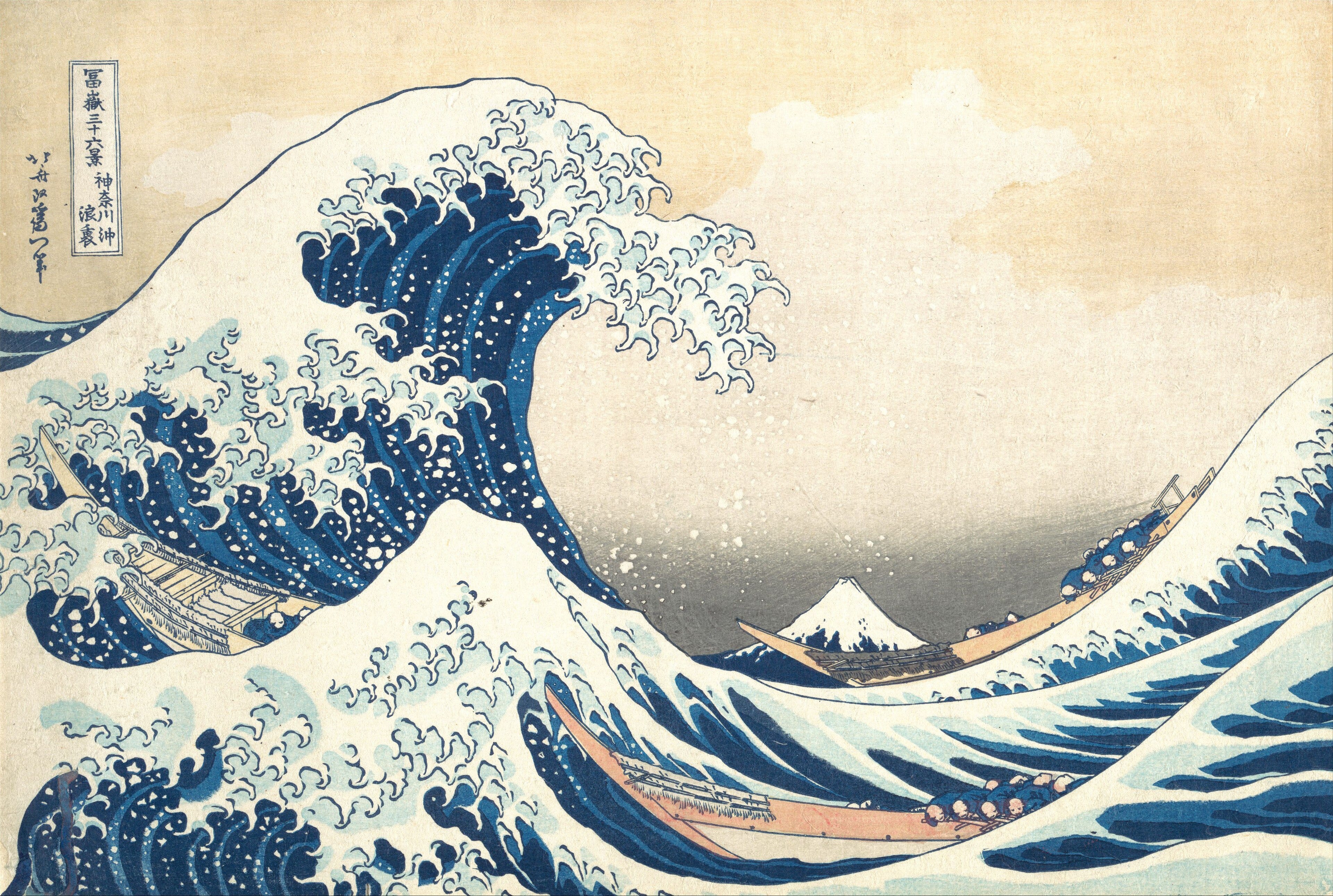
The future is more complicated. As we are poised there, helpless before the rogue wave of time, we see the inevitability of falling water and imagine that we hear the crash before it happens. We are Hokusai’s boatmen, frozen for eternity at the instant past becomes future. The predictive power of the brain, immersed in a hospitable pocket of a seemingly orderly universe, has taught us what to expect, even to the point that expectations become routine. We tend to ignore time because it seems both predictable and familiar. That familiarity is due to remembered experience and the ability to weave experience into a model of what was, what is happening, and what may yet come to be.
Has anyone escaped the confines of this mental model of time? None have done so completely, but a few have come close. Their journeys provide clues to our personal connection to time.
Henry Molaison, one of neuroscience’s most consequential research participants, is best known for the profound memory deficits that followed a bilateral medial temporal lobe surgery intended to treat his intractable epilepsy. The operation damaged brain regions essential for forming new declarative memories, including hippocampal and neighboring medial temporal structures. Henry possessed a profound anterograde amnesia, and he took part in one of the longest-running human studies in brain science as “Patient H.M.”.
Most of the tests Henry took were tests of memory. But a lesser-known paper published by Whitman Richards in 1973 tested his perception of time. Richards asked Henry to estimate intervals in a simple task. The experimenter would say “go” and then, after different timed intervals, “stop.” Henry was then asked to reproduce the interval he had just heard, up to a duration of 300 seconds.
Most people can do this fairly well. If their estimated time is plotted against actual time, the data fall roughly along a diagonal line. But Henry’s data looked different.
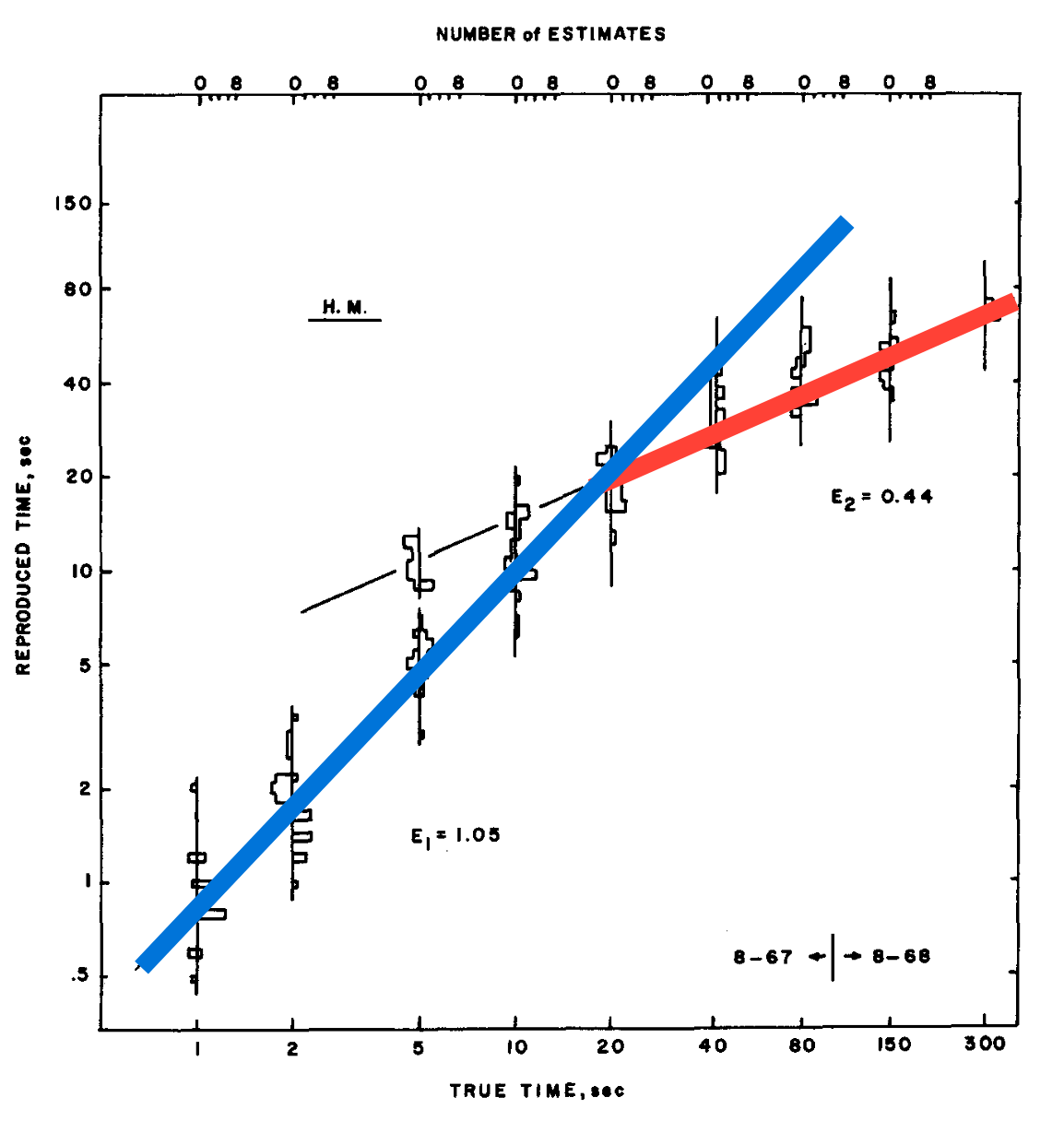
Henry did well at repeating short intervals. But for longer intervals, his sense of time began to fray. His errors could have gone in either direction, yet he consistently underestimated longer durations. Henry’s memory window (the longest span over which he could retain newly acquired declarative information) was on the order of 20 seconds. His timing errors increased as the task pushed him beyond that window.
You or I can still tap a rhythm, blink at the right instant, or coordinate movement without building a rich autobiographical record of the moment. But Henry’s performance suggested something more subtle: the felt duration of extended experience, the ability to know what a minute has been like as it passes, depends partly on memory systems that stitch moments together.
The short intervals remained within reach of Henry’s mind. As the interval lengthened, time itself began to lose continuity. He could still stand in the moment, but he could no longer hold enough of the passing moment to feel its full duration.
This notion of memory’s involvement in time perception first seems at odds with time flying “when you’re having fun” and the apparent slowness of watched pots coming to a boil. A fun activity with simple demands may be no less enjoyable than a complex activity. The difference is that, in the watched-pot case, attention is fixed on elapsed time instead of being carried away by a more engaging object. Tasks that take the mind away from the passage of time distort perception. We become too distracted to plant the flags that mark the moments.
That may be one reason novelty stretches experience. New places, new people, unfamiliar problems, and emotionally charged events create more landmarks in memory. Routine compresses time. We look back on a period with few signposts and find little to measure. A day can be full while it is happening and strangely thin in retrospect. A week of travel can feel longer and richer than a month of repetition.
If memory is essential to the sense of lived time, do diseases that rob us of memory alter our relationship with time?
Alzheimer’s disease (AD) does not only erase the recall of names, appointments, and recent conversations, it alters a person’s location in time. Early on, the disruption may seem ordinary: a misplaced object or a repeated question. But these are also temporal failures. The recent past no longer holds its shape. The mind may have difficulty placing the self in the sequence of the day. More disturbing, the AD patient may find themselves feeling unmoored from the current moment, and displaced to one from the past. Time becomes less like a continuous road and more like a set of disconnected rooms. Some memories remain with striking clarity: of childhood, old music, or the face of a long-deceased parent. Others dissolve almost as soon as the moment passes through them.
Reminiscent of H.M., but owing to more extensive circuit involvement, even in dementia some short-duration timing may remain partly intact, especially when the task depends on rhythm, motor coordination, or immediate attention. But longer time is different. Longer time must be bound together with memory, context, and expectation.
Korsakoff syndrome offers a related but distinct example. Often associated with chronic thiamine deficiency and alcohol use disorder, it can produce profound anterograde amnesia, confabulation, and temporal disorientation. People with Korsakoff syndrome may speak fluently and appear to be socially present, yet be unable to retain the recent past long enough to keep themselves oriented in time. In retrospective estimates, elapsed time may be underestimated (similar to H.M.), as though periods without durable memory traces collapse when the mind tries to reconstruct them.
These disorders suggest that memory is more than an archive of lived time. It is one of the instruments by which lived time is perceived. It also raises the possibility that changes in subjective duration, temporal orientation, and the ability to order recent events may become useful clues in detecting cognitive decline.
“Tomorrow” appears to be a mental model based on an extrapolation of yesterday into the future, with ourselves placed inside the imagined scene. Endel Tulving and Daniel Schacter examined the role of memory in this process. They studied another amnesic patient known by the initials K.C., whose hippocampus and other brain regions were damaged in a motorcycle accident. K.C. provided an opportunity to examine how profound deficits in episodic memory could erase the ability to imagine the future. When asked to imagine his future, he drew a blank.
Studies of individuals with more circumscribed hippocampal damage support the point. In 2007, Hassabis and colleagues asked subjects with bilateral hippocampal damage to imagine future scenes. The subjects could often produce fragments—objects, details, isolated facts—but had difficulty arranging those fragments into a coherent whole. They could summon pieces of a world, but they struggled to inhabit it. This is what Tulving called mental time travel, later formalized by Schacter and Addis as the constructive episodic simulation hypothesis: memory doesn’t just store the past, it supplies the raw material the mind recombines into imagined futures.
The hippocampus is no longer viewed only as a memory archive, a place where finished experiences are stored after they occur. Human recordings now show neurons in the hippocampus and entorhinal cortex that fire at particular moments in an unfolding experience. These “time cells” help organize sequences, binding events to their temporal location. Animal studies have also shown that the lateral entorhinal cortex carries information about the temporal structure of experience across seconds, minutes, and even longer spans. It’s the brain’s attempt to bind what happened, where it happened, and when it happened into a usable map.
It is dangerous to extrapolate too much from special cases, because the hippocampus is extensively connected to the rest of the brain. Damage or removal of hippocampal tissue not only affects the hippocampus proper, but far-ranging networks connected to it as well. Still, neuroimaging studies have implicated many of the same hippocampal and prefrontal networks when subjects recall prior events and when they imagine future events. The right hippocampus appears especially engaged during future imagining.
This hippocampal involvement has implications beyond what brain regions “light up” during the complex activity of imagining the future. One of the major functions of the hippocampal formation is to encode the memory of place. Arrays of cells within it help represent specific positions in space. Strong hippocampal activation during future imagining raises a natural question. Could one consequence of amnesia be a deficit in the ability to place ourselves in a future narrative frame? Older adults also show changes in the precision of episodic memory, which appear to coincide with reduced fidelity of future imagination. Is one consequence of age-related memory loss a subtle weakening in the ability to imagine ourselves in our own future? Perhaps.
If the hippocampus is like a compass defining our place in the immediate world, these studies, and others, suggest it may also serve as the GPS for mental time travel.
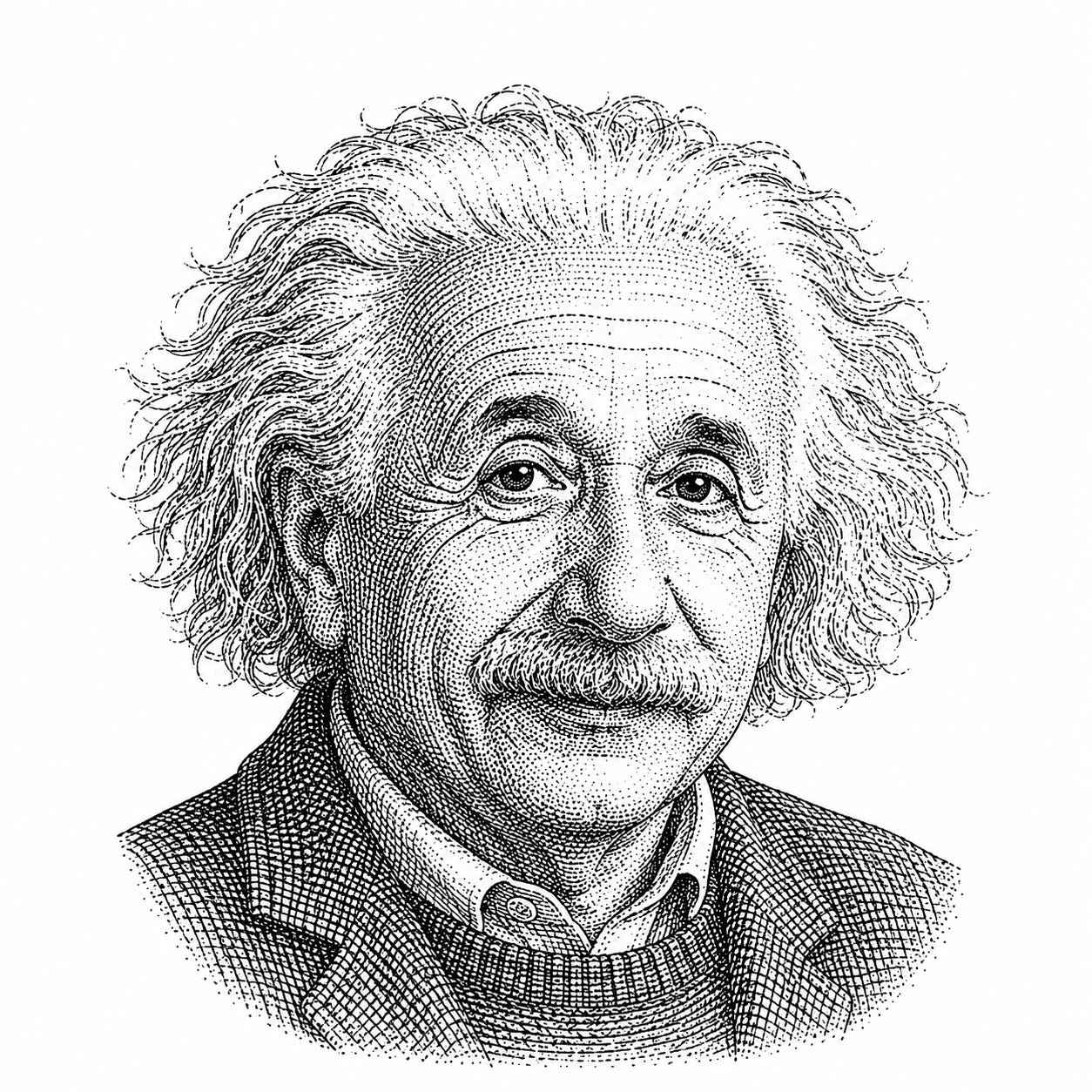
In a parallel with Emily Dickinson, Albert Einstein once said, “Imagination is more important than knowledge.” It is always treacherous to disagree with Einstein, but I will suggest that this famous quote presents a false choice. The key elements of imagination appear to depend intimately on the retention and reworking of prior knowledge. The imagined future is assembled from fragments of our past memories. They’re inextricable.
Age begins to sneak time from us with each passing year. Just as the rise of the world’s oceans may be imperceptible in the short term, our sense of time may shift gradually as we age. In youth, a passing year is a large percentage of the total time we have existed. At age four, a year is fully a quarter of one’s life. The events that populate young lives are infused with novelty and meaning as the brain learns to make sense of an alien planet. They are marked by firsts: the first birthday remembered, the first friend, the first touch of grief, the first time standing at the edge of an ocean, the first realization that adults don’t know everything.
As we age, it becomes easier to feel we’ve “been there, done that”, and harder to encounter the unfamiliar. That expansive youthful year becomes a tiny fraction of a life approaching eighty, closing in on a single percent. The calendar still contains the same twelve months, but the mind measures lived time by change, memory, and event boundaries. This may underlie the cognitive benefits of travel, new friendships, new work, and absorbing hobbies. These things may matter because they provide the signposts of living and change, helping us build and preserve our place in time.
The trick to a longer-seeming life, and perhaps to the ability to imagine a richer future, may be to create wonderful memories and dwell on them long enough to make them durable markers of a lived life. Could this mean that a little social media narcissism is not such a bad thing? Perhaps taking the picture, telling the story, or calling an old friend are all small acts of resistance against time’s compression. They say: this happened; I was there; I remember it, and it mattered.
Our reliance on memory to structure our sense of time, including our future sense, also suggests that imagination is bounded by the experiences we remember, even when those memories are of imaginings rather than direct events. We can imagine the beginning of the universe, though we never witnessed it. We can imagine the death of the sun, though none of us will see it. We can think past the span of our own lives and place ourselves, however briefly, inside the majesty of cosmic time.
Time is stranger than it feels. Relativity suggests there is no one cosmic “now” dividing all events into past and future. Thermodynamics gives direction to time’s arrow in the form of entropy, but we can only guess at the arrow’s path. Cosmology reminds us that a single human life is a blip in the more expansive lifetime of the universe. None of these models explains why time feels like something we live through. That may be the work of memory, storing the now.
As Dickinson also wrote:
“Forever - is composed of Nows
‘Tis not a different time
Except for Infiniteness
And Latitude of Home”
The brain turns successive moments into events, events into stories, and stories into a felt sense of self in time. It gathers the irreversible changes of the world—growth, aging, loss, recovery, and decay—and transmutes them into the experience of a life moving forward. The moments we experience in the here and now are held long enough to become memories, and those memories are recombined richly enough to imagine what may come next.
Thanks for your time.
Dwayne Godwin is a Professor of Translational Neuroscience at the Wake Forest University School of Medicine. He is the co-Author of “Out of Your Mind: The Biggest Mysteries of the Human Brain.”
This commentary should not be interpreted as reflecting the views of his employer.
For Further Exploration
Addis, D. R., Wong, A. T., & Schacter, D. L. (2007). Remembering the past and imagining the future: Common and distinct neural substrates during event construction and elaboration. Neuropsychologia, 45(7), 1363–1377. https://doi.org/10.1016/j.neuropsychologia.2006.10.016
Annese, J., Schenker-Ahmed, N. M., Bartsch, H., Maechler, P., Sheh, C., Thomas, N., Kayano, J., Ghatan, A., Bresler, N., Frosch, M. P., Klaming, R., & Corkin, S. (2014). Postmortem examination of patient H.M.’s brain based on histological sectioning and digital 3D reconstruction. Nature Communications, 5, Article 3122. https://doi.org/10.1038/ncomms4122
Buhusi, C. V., & Meck, W. H. (2005). What makes us tick? Functional and neural mechanisms of interval timing. Nature Reviews Neuroscience, 6(10), 755–765. https://doi.org/10.1038/nrn1764
Carroll, S. (2010). From eternity to here: The quest for the ultimate theory of time. Dutton.
Coull, J. T., Cheng, R.-K., & Meck, W. H. (2011). Neuroanatomical and neurochemical substrates of timing. Neuropsychopharmacology, 36(1), 3–25. https://doi.org/10.1038/npp.2010.113
Dickinson, E. (1998). The poems of Emily Dickinson: Variorum edition (R. W. Franklin, Ed.). Belknap Press of Harvard University Press. Original work composed ca. 1862.
Dickinson, E. (2024, January 26). Forever – is composed of Nows –. Wikisource. Retrieved July 9, 2026, from wikisource.org
Eddington, A. S. (1928). The nature of the physical world. The Macmillan Company; Cambridge University Press.
El Haj, M., Kapogiannis, D., & Antoine, P. (2016). Time distortions in Alzheimer’s disease: A systematic review and theoretical integration. npj Aging and Mechanisms of Disease, 2, Article 16016. https://doi.org/10.1038/npjamd.2016.16
El Haj, M., Nandrino, J.-L., Kessels, R. P. C., Matton, C., Bacquet, J.-E., Urso, L., & Antoine, P. (2017). Retrospective time perception in Korsakoff’s syndrome. The Journal of Neuropsychiatry and Clinical Neurosciences, 29(3), 245–251. https://doi.org/10.1176/appi.neuropsych.16100206
Godwin, D. (2015). Remembering the future. BrainFacts.org. https://www.brainfacts.org/neuroscience-in-society/the-arts-and-the-brain/2015/remembering-the-future
Hassabis, D., Kumaran, D., Vann, S. D., & Maguire, E. A. (2007). Patients with hippocampal amnesia cannot imagine new experiences. Proceedings of the National Academy of Sciences, 104(5), 1726–1731. https://doi.org/10.1073/pnas.0610561104
Hokusai, K. (ca. 1830–1832). Under the Wave off Kanagawa (Kanagawa oki nami ura), also known as The Great Wave, from the series Thirty-six Views of Mount Fuji (Fugaku sanjūrokkei) [Woodblock print; ink and color on paper]. The Metropolitan Museum of Art. https://www.metmuseum.org/art/collection/search/45434
Korkki, S. M., Richter, F. R., Jeyarathnarajah, P., & Simons, J. S. (2020). Healthy ageing reduces the precision of episodic memory retrieval. Psychology and Aging, 35(1), 124–142. https://doi.org/10.1037/pag0000432
MacDonald, C. J., Lepage, K. Q., Eden, U. T., & Eichenbaum, H. (2011). Hippocampal “time cells” bridge the gap in memory for discontiguous events. Neuron, 71(4), 737–749. https://doi.org/10.1016/j.neuron.2011.07.012
Matell, M. S., & Meck, W. H. (2004). Cortico-striatal circuits and interval timing: Coincidence detection of oscillatory processes. Cognitive Brain Research, 21(2), 139–170. https://doi.org/10.1016/j.cogbrainres.2004.06.012
Pastalkova, E., Itskov, V., Amarasingham, A., & Buzsáki, G. (2008). Internally generated cell assembly sequences in the rat hippocampus. Science, 321(5894), 1322–1327. https://doi.org/10.1126/science.1159775
Reddy, L., Zoefel, B., Possel, J. K., Peters, J. C., Dijksterhuis, D., Poncet, M., van Straaten, E. C. W., Baayen, J. C., Idema, S., & Self, M. W. (2021). Human hippocampal neurons track moments in a sequence of events. The Journal of Neuroscience, 41(31), 6714–6725. https://doi.org/10.1523/JNEUROSCI.3157-20.2021
Richards, W. (1973). Time reproductions by H.M. Acta Psychologica, 37(4), 279–282. https://doi.org/10.1016/0001-6918(73)90020-6
Rosenbaum, R. S., Köhler, S., Schacter, D. L., Moscovitch, M., Westmacott, R., Black, S. E., Gao, F., & Tulving, E. (2005). The case of K.C.: Contributions of a memory-impaired person to memory theory. Neuropsychologia, 43(7), 989–1021. https://doi.org/10.1016/j.neuropsychologia.2004.10.007
Rovelli, C. (2018). The order of time (E. Segre & S. Carnell, Trans.). Riverhead Books. Original work published 2017.
Schacter, D. L., Addis, D. R., Hassabis, D., Martin, V. C., Spreng, R. N., & Szpunar, K. K. (2012). The future of memory: Remembering, imagining, and the brain. Neuron, 76(4), 677–694. https://doi.org/10.1016/j.neuron.2012.11.001
Schacter, D. L., Gaesser, B., & Addis, D. R. (2013). Remembering the past and imagining the future in the elderly. Gerontology, 59(2), 143–151. https://doi.org/10.1159/000342198
Scoville, W. B., & Milner, B. (1957). Loss of recent memory after bilateral hippocampal lesions. Journal of Neurology, Neurosurgery & Psychiatry, 20(1), 11–21. https://doi.org/10.1136/jnnp.20.1.11
Tacikowski, P., Kalender, G., Ciliberti, D., & Fried, I. (2024). Human hippocampal and entorhinal neurons encode the temporal structure of experience. Nature, 635, 160–167. https://doi.org/10.1038/s41586-024-07973-1
Teghil, A., Boccia, M., Bonavita, A., Guariglia, C., & Giannini, A. M. (2023). Multidimensional assessment of time perception along the Alzheimer’s disease continuum. Scientific Reports, 13, Article 22908. https://doi.org/10.1038/s41598-023-49222-x
Tsao, A., Sugar, J., Lu, L., Wang, C., Knierim, J. J., Moser, M.-B., & Moser, E. I. (2018). Integrating time from experience in the lateral entorhinal cortex. Nature, 561(7721), 57–62. https://doi.org/10.1038/s41586-018-0459-6
Tulving, E. (1985). Memory and consciousness. Canadian Psychology/Psychologie canadienne, 26(1), 1–12. https://doi.org/10.1037/h0080017
Tulving, E. (2002). Episodic memory: From mind to brain. Annual Review of Psychology, 53, 1–25. https://doi.org/10.1146/annurev.psych.53.100901.135114
Tulving, E., Schacter, D. L., McLachlan, D. R., & Moscovitch, M. (1988). Priming of semantic autobiographical knowledge: A case study of retrograde amnesia. Brain and Cognition, 8(1), 3–20. https://doi.org/10.1016/0278-2626(88)90035-8
Umbach, G., Kantak, P., Jacobs, J., Kahana, M., Pfeiffer, B. E., Sperling, M., & Lega, B. (2020). Time cells in the human hippocampus and entorhinal cortex support episodic memory. Proceedings of the National Academy of Sciences, 117(45), 28463–28474. https://doi.org/10.1073/pnas.2013250117
Viereck, G. S. (1929, October 26). What life means to Einstein: An interview by George Sylvester Viereck. The Saturday Evening Post, 17, 110, 113–114, 117.
Wittmann, M. (2016). Felt time: The psychology of how we perceive time (E. Butler, Trans.). MIT Press. (Original work published 2015)
© 2026 Dwayne Godwin. Developed from an essay originally published at BrainFacts.org (2015).